Think all Dachshunds look alike? Think again.
The Dachshund is one of the most visually diverse breeds on the planet — coming in 2 sizes, 3 coat types, more than a dozen colors, and 4 distinct patterns. When you do the math, that’s hundreds of possible Dachshund “looks,” each one as charming and quirky as the next.
Whether you’re trying to identify your Doxie’s exact type, deciding which Dachshund to bring home, or just curious about the breed, this complete guide breaks down everything you need to know — from the iconic Standard Smooth Red to the rare Isabella Dapple and beyond.
Related post: Which Dachshund Should I Get?
How Many Types of Dachshunds Are There?
If you count every possible combination of size, coat, color, and pattern, there are literally hundreds of Dachshund variations. According to the American Kennel Club, Dachshunds come in more colors and patterns than any other breed.
Here’s the breakdown of the four core categories:
- Sizes (2): Standard, Miniature
- Coat Types (3): Smooth, Longhaired, Wirehaired
- Colors (11+): Red, Cream, Black & Tan, Black & Cream, Chocolate & Tan, Chocolate & Cream, Blue & Tan, Blue & Cream, Isabella & Tan, Isabella & Cream, Wild Boar
- Patterns (4): Piebald, Brindle, Dapple, Sable
Every Dachshund you meet has all four characteristics — for example, a “Standard Smooth Red” or a “Miniature Longhaired Black & Tan Dapple.” Once you know how to read these labels, identifying any Doxie becomes second nature.

Dachshund Sizes
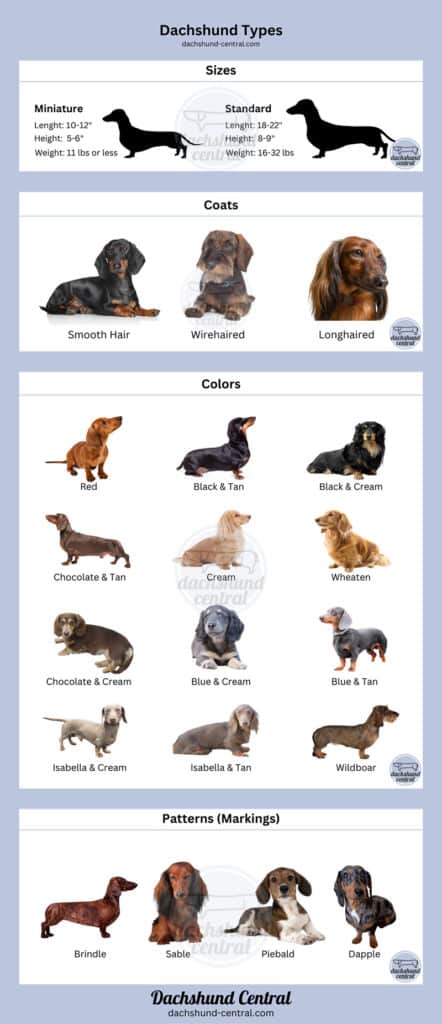
The American Kennel Club officially recognizes two sizes of Dachshund: Standard and Miniature. A third “size” — the Kaninchen or Rabbit Dachshund — is recognized in some international registries.
Related post: How Big Do Dachshunds Get?
Standard Dachshund
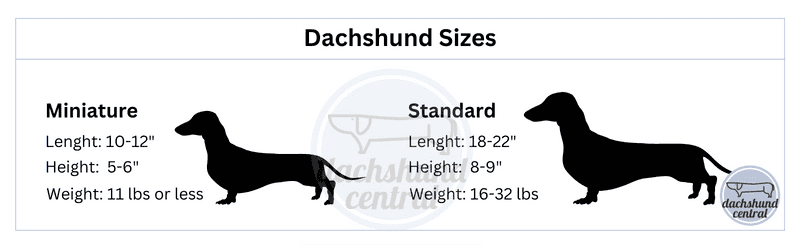
The Standard is the larger of the two AKC-recognized sizes — and the original Dachshund developed in Germany for hunting badgers.
- Weight: 16–32 pounds
- Body length: ~18–22 inches
- Height at shoulder: 9–12 inches
- Best for: Active families, those who want a slightly sturdier dog
Miniature Dachshund
The Miniature is roughly half the size of the Standard. They were developed in the late 1800s for hunting smaller burrow animals like rabbits and ferrets.
- Weight: 11 pounds and under (at 12 months or older)
- Body length: ~10–12 inches
- Height at shoulder: 5–6 inches
- Best for: Apartment living, smaller homes, families with older kids
Both sizes share the same temperament, intelligence, and stubborn streak — the only real difference is how much dog you’re carrying around.
Related posts: Standard Dachshund vs Miniature Dachshund | Are Toy Dachshunds Real?
Kaninchen (Rabbit) Dachshund
The Kaninchen is the smallest type of Dachshund — a German word meaning “rabbit.” While the AKC does not recognize Kaninchens as a separate size, the Fédération Cynologique Internationale (FCI) classifies any Dachshund weighing under 3.5 kg (7.7 lbs) with a chest measurement of 30 cm (11.8 inches) or less as a Kaninchen.
- Weight: Under 7.7 pounds
- Chest measurement: 11.8 inches or less
- Recognition: FCI yes, AKC no
In the U.S., a Kaninchen-sized Dachshund is simply registered as a Miniature.
Related post: Rabbit Dachshund: The Smallest Type of Dachshund
Dachshund Coat Types
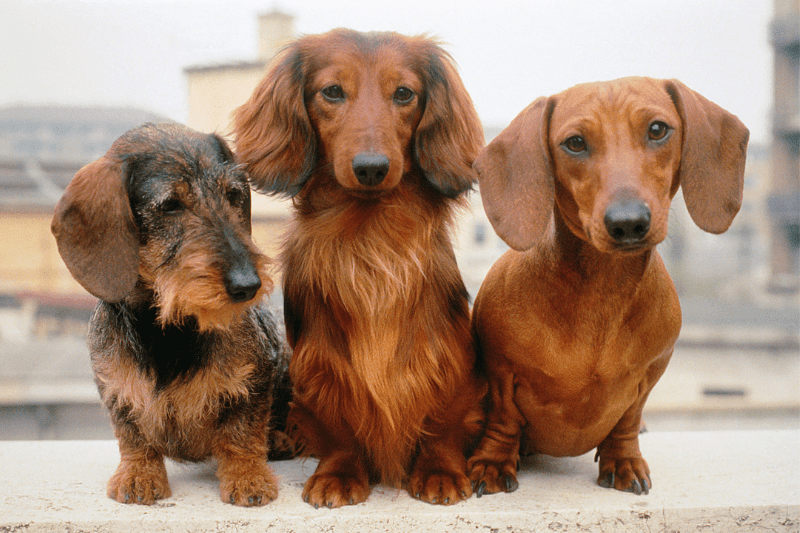
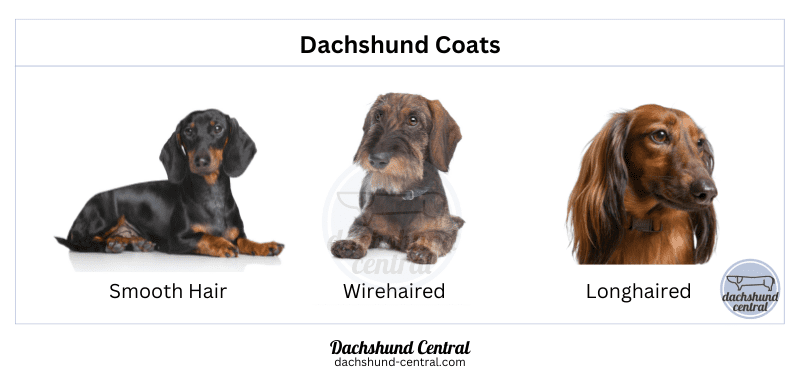
All Dachshunds — Standard or Miniature — come in three distinct coat types. Each has its own grooming needs, temperament tendencies, and aesthetic appeal.
Smooth-Haired Dachshund
The most common and original coat type. Smooth Dachshunds have a short, shiny, sleek coat that lies flat against the body.
- Grooming needs: Minimal — a quick brush once a week
- Sheds: Moderately, year-round
- Temperament tendency: Classic Doxie energy — bold, curious, playful
- Cold tolerance: Low — a sweater is often needed in winter
Longhaired Dachshund
Long, soft, often slightly wavy fur with feathering on the ears, chest, legs, and tail. Often described as the most elegant-looking variety.
- Grooming needs: Moderate — brushing several times per week to prevent matting
- Sheds: Moderately, with seasonal blow-outs
- Temperament tendency: Often calmer, gentler, and sometimes more cuddly than the other coat types
- Cold tolerance: Moderate — better-insulated than smooth coats
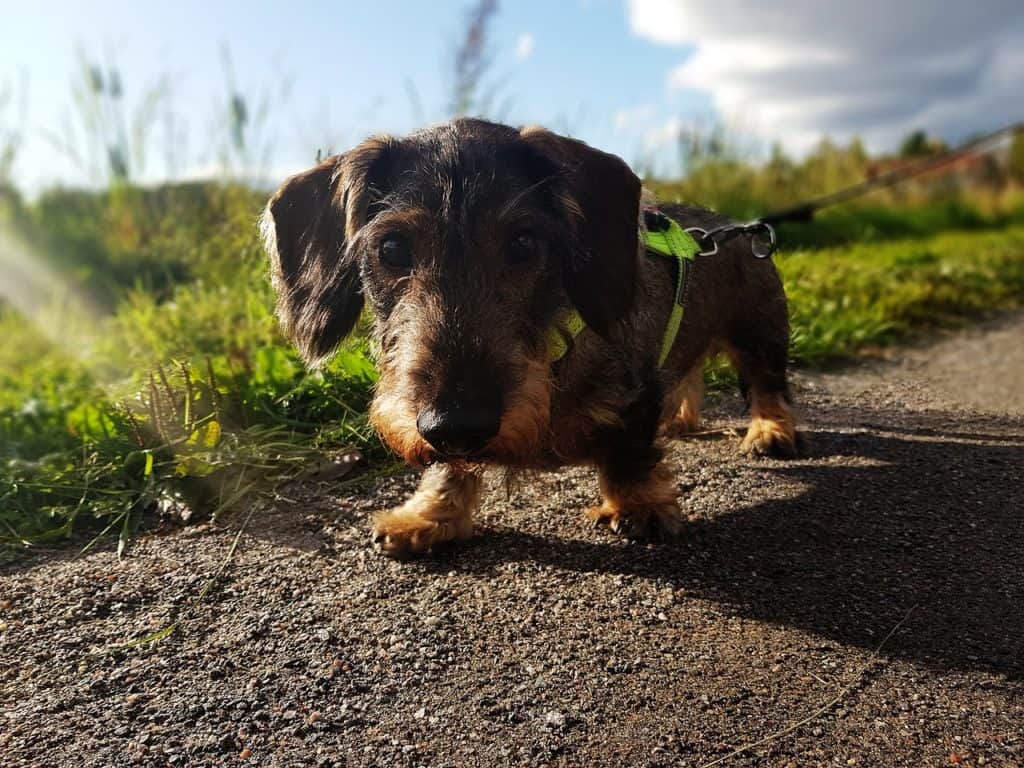
Wirehaired Dachshund
Wire Dachshunds have a thick, wiry outer coat with a softer undercoat — plus a distinctive beard and eyebrows that give them a charming, expressive face. The wire coat was developed later than the other two by crossing Dachshunds with terriers.
- Grooming needs: Specialized — usually requires hand-stripping or professional grooming twice a year
- Sheds: Less than smooth or longhaired
- Temperament tendency: More terrier-like — outgoing, mischievous, often called the “clowns” of the breed
- Cold tolerance: Highest of the three coat types
Dachshund Colors
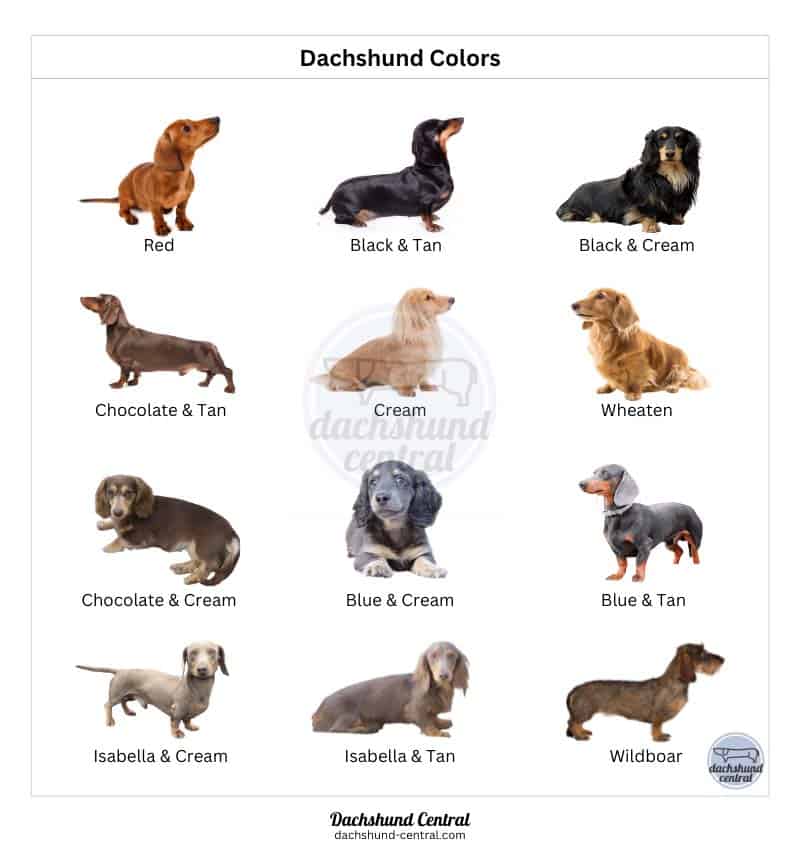
The AKC officially recognizes over 15 color and color-combination options for Dachshunds. They fall into three categories: one-color, two-color, and the unique wild boar coloring.
One-Color Dachshunds
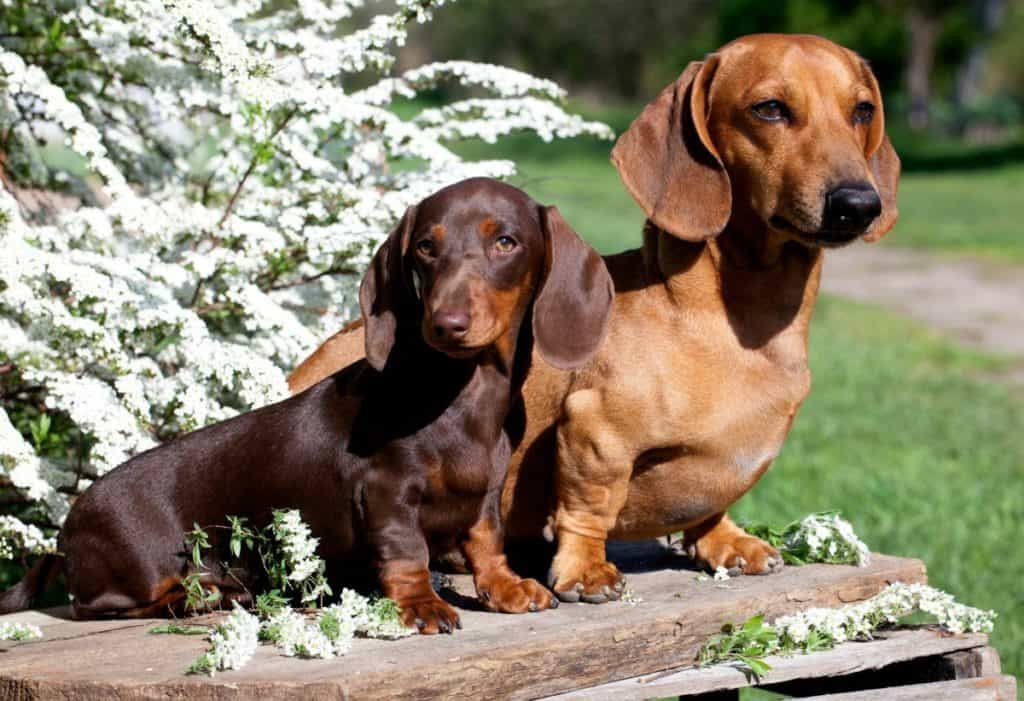
One-color (or “self-color”) Dachshunds have a single solid color across the whole body. The two recognized one-color varieties are:
Red Dachshund
The most iconic and common Dachshund color. Reds range from deep mahogany to light golden-tan, often with a subtle sheen. Some red Dachshunds have small amounts of black hairs interspersed throughout the coat (sometimes mistakenly called “sable”) — this is technically called “shading” and is perfectly normal.
Cream Dachshund
A pale, golden-blonde shade ranging from almost-white to warm buttery cream. The pure cream color comes from a recessive gene, and the most prized variety is the English Cream, known for being especially light, soft, and elegant — most often seen in longhaired Dachshunds.
Related post: The English Cream Dachshund
Two-Color Dachshunds
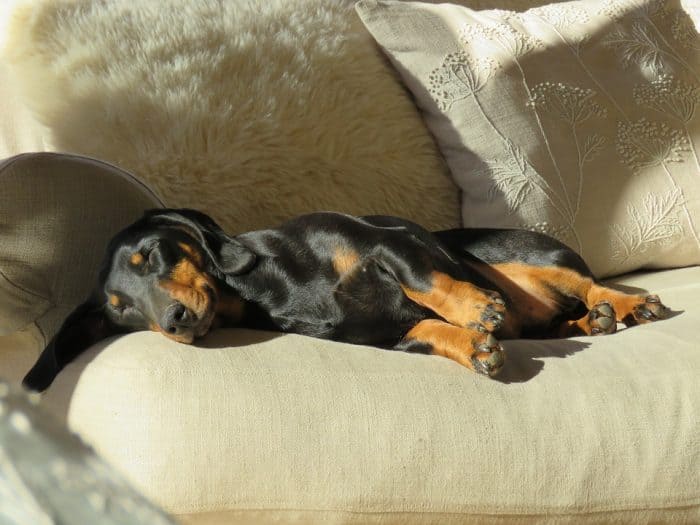
Two-color Dachshunds have a base color (black, chocolate, blue, or Isabella) with tan or cream “points” — markings above the eyes, on the muzzle, chest, legs, and under the tail.
The 8 recognized two-color combinations are:
| Combination | Description | Rarity |
|---|---|---|
| Black & Tan | Shiny black with rich reddish-brown markings — the classic, elegant Doxie look | Common |
| Black & Cream | Shiny black with pale cream markings instead of tan | Less common |
| Chocolate & Tan | Rich brown base with tan points and brown nose | Common |
| Chocolate & Cream | Brown base with cream points | Less common |
| Blue & Tan | Diluted black — a soft steel-gray base with tan points | Rare |
| Blue & Cream | Steel-gray base with cream points | Rare |
| Isabella & Tan | Diluted chocolate — a fawn/lilac base with tan points and pinkish-brown nose | Very rare |
| Isabella & Cream | Fawn/lilac base with cream points | Very rare |
About the dilute colors: Blue and Isabella Dachshunds get their unique color from a recessive dilution gene that lightens black to gray-blue and chocolate to fawn. While stunning, dilute Dachshunds are at higher risk for Color Dilution Alopecia (CDA) — a condition that can cause coat thinning and skin issues. Reputable breeders health-test for this.
Wild Boar Dachshund
Wild Boar (also called “agouti”) is one of the most unique colorings in the breed. Each individual hair has multiple bands of color — typically gray, black, and brown over a red or chocolate base. The result is a beautiful grizzled, tweed-like appearance.
Wild Boar is most often seen in wirehaired Dachshunds, where the texture of the coat enhances the multi-toned effect, but it can also appear in smooth and longhaired varieties. Variations include:
- Standard Wild Boar: Gray, black, and brown banding over red
- Red Boar: Lighter red base with gray-brown banding
- Chocolate-and-Tan Boar: Banding over chocolate with tan points

Dachshund Patterns
Patterns are layered on top of a Dachshund’s base color. A single dog can be described as a “Black & Tan Dapple” or a “Red Brindle” — the base color first, then the pattern. There are four recognized patterns.
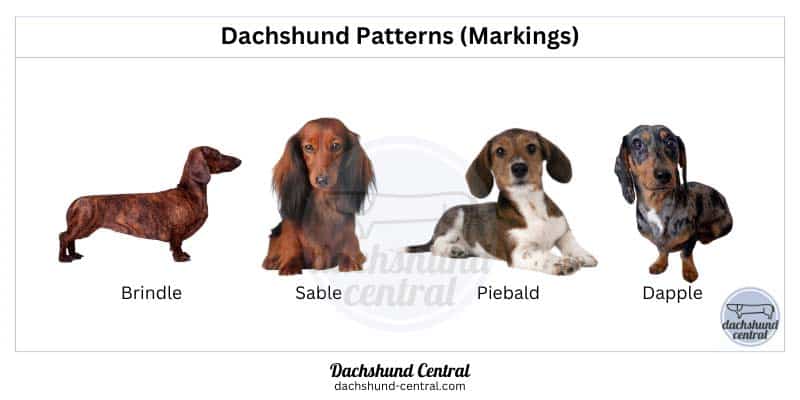
Piebald Dachshunds
Piebald is characterized by clearly defined patches of white over a base color, typically on the chest, belly, legs, and sometimes the face. Piebald Doxies often have a striking, almost cow-like spotted appearance.
This pattern can occur in any one-color or two-color combination — for example, a “Red Piebald” or “Chocolate & Tan Piebald.” Unlike dapple, piebald is not associated with the same health risks, making it a safer “patterned” choice.
Related post: Everything You Need to Know About Piebald Dachshunds
Brindle Dachshunds
Brindle is a tiger-stripe pattern with darker stripes (typically black or chocolate) running over a lighter base color (usually red or tan). The stripes are most visible on red brindles; on black-and-tan brindles, the stripes only show in the tan points.
Brindle can appear in any coat type but is most striking in smooth and longhaired Dachshunds.
Related post: What Is a Brindle Dachshund?
Dapple (Merle) Dachshunds
Dapple is the Dachshund equivalent of the merle gene seen in breeds like Australian Shepherds. It produces a mottled, speckled, or marbled appearance with lighter patches of color over a darker base.
Dapples often have:
- Random light splotches scattered across a darker coat
- One or both blue eyes (or partially blue “wall eyes”)
- A small white patch on the chest
Dapple can occur in any base color — Black & Tan Dapple, Red Dapple, Chocolate Dapple, etc. Single dapple (one copy of the merle gene) is perfectly safe and AKC-recognized.
Related post: What Is a Dapple Dachshund?
Sable Dachshunds
True Sable is a rare pattern that only occurs in longhaired Dachshunds. Each individual hair has a red or tan base that fades to black at the tip, creating a beautifully shaded, almost dual-toned effect across the entire coat.
Important: many “sable-looking” red Dachshunds are not actually sable — they’re just red dogs with shading (interspersed black hairs). True sable requires the multi-colored individual hair shafts.
Related post: What Is a Sable Dachshund?

A Word on Double Dapple Dachshunds
If you’ve come across a Dachshund described as “double dapple” — please read this section carefully.
A double dapple is the result of breeding two dapple Dachshunds together, producing a dog with two copies of the merle gene. While double dapples often have striking, mostly white coats with patches of color, they are at significantly higher risk for serious health problems, including:
- Deafness in one or both ears
- Blindness or severely reduced vision
- Microphthalmia (abnormally small eyes)
- Other eye and ear malformations
Per the AKC breed standard and major breed-health resources, breeding two dapples is strongly discouraged. If a breeder is offering “double dapple” or “double merle” puppies, that’s a major red flag — walk away.
Which Dachshund Type Is the Rarest?
If you’re hunting for the rarest Dachshund out there, here’s the leaderboard:
- Isabella & Cream: The rarest standard Dachshund color — extremely difficult to breed because both parents must carry the recessive dilution gene.
- Isabella & Tan: Slightly less rare than Isabella & Cream, but still uncommon.
- Blue & Cream / Blue & Tan: Beautiful diluted black coats, also requiring two recessive genes to express.
- True Sable: Only occurs in longhaired Dachshunds and is genuinely rare.
- Wild Boar in non-wirehaired coats: Wild Boar smooth or longhaired Dachshunds are uncommon.
Important caveat: “Rare” doesn’t always mean “better.” Rare colors often command higher prices, but they can also come with higher health risks (especially the dilute colors). A reputable breeder will always prioritize health over coat color.
Quick Reference Chart
Here’s a cheat sheet you can save or screenshot for quick identification:
| Category | Options |
|---|---|
| Sizes | Standard, Miniature (Kaninchen — FCI only) |
| Coat Types | Smooth, Longhaired, Wirehaired |
| One-Color | Red, Cream |
| Two-Color | Black & Tan, Black & Cream, Chocolate & Tan, Chocolate & Cream, Blue & Tan, Blue & Cream, Isabella & Tan, Isabella & Cream |
| Special Color | Wild Boar (most common in wirehaired) |
| Patterns | Piebald, Brindle, Dapple (Merle), Sable |
| Avoid | Double Dapple (significant health risks) |
To identify any Dachshund, simply combine: Size + Coat + Color + Pattern (if applicable). Example: “Miniature Longhaired Black & Tan Dapple.”
Related post: What Were Dachshunds Bred For?
Frequently Asked Questions
How many types of Dachshunds are there?
If you count every combination of size, coat, color, and pattern, there are hundreds of possible Dachshund types. The core breakdown is 2 sizes × 3 coat types × 11+ colors × 4 patterns. The AKC officially recognizes 15+ color combinations.
What’s the most common type of Dachshund?
The Standard Smooth Red is the most iconic and widely seen Dachshund — it’s the classic image most people picture when they think of the breed. Black & Tan smooth Dachshunds are a close second.
What’s the rarest type of Dachshund?
The Isabella & Cream Dachshund is the rarest of the AKC-recognized colors, requiring two copies of recessive genes from both parents. True sable longhaired Dachshunds are also genuinely uncommon.
Do all colors come in all coat types?
Mostly yes. Red, cream, black & tan, chocolate & tan, blue, and isabella all appear across smooth, longhaired, and wirehaired coats. Wild boar is most common in wirehaired but can appear in others. True sable, however, only occurs in longhaired Dachshunds.
Do different Dachshund types have different personalities?
Coat type can correlate with personality tendencies: longhaired Doxies are often calmer and gentler, smooth-coated are classic bold Dachshund energy, and wirehaired tend to be more terrier-like and mischievous (because they were bred with terriers). Color and pattern, however, don’t affect personality.
Are colored Dachshunds healthier than rare ones?
Generally, yes. Standard colors (red, black & tan) come from dominant genes and tend to be the healthiest. Dilute colors like blue and isabella can carry a higher risk of Color Dilution Alopecia, and double-dapple Dachshunds are at serious risk for blindness and deafness.
What’s a Kaninchen Dachshund?
“Kaninchen” is German for “rabbit.” It’s the smallest Dachshund size — under 7.7 lbs — recognized by the FCI in Europe but not by the AKC in the U.S. Stateside, these dogs are simply registered as Miniatures.
How do I know what type my Dachshund is?
Identify these in order: (1) Size — Standard or Miniature; (2) Coat — smooth, longhaired, or wirehaired; (3) Base Color — red, cream, black & tan, chocolate & tan, blue, isabella, or wild boar; (4) Pattern — piebald, brindle, dapple, sable, or none. Combine them: “Miniature Longhaired Red Dapple.”
Final Thoughts: The Many Faces of the Dachshund
Dachshunds may all share the same charming sausage-shaped silhouette, but inside that long, low frame is one of the most diverse and beautiful breeds in the dog world. Whether yours is a sleek Smooth Red, an elegant Longhaired Cream, a bearded Wirehaired Wild Boar, or a striking Black & Tan Dapple — each type has its own unique appeal.
When choosing a Dachshund, the most important things to focus on are health, temperament, and breeder reputation — not coat color. A reputable breeder will be happy to explain their lines, share health testing, and steer you away from any combinations (like double dapples) that pose risks. A “rare” coat color from a careless breeder is never worth the heartbreak of preventable health issues.
Once you’ve found a healthy, well-bred Dachshund, the rest is just gravy — and you’ll quickly discover that no matter what type you bring home, you’ve signed up for a small, brave, opinionated, devoted little dog who will make you laugh every day for the next 12 to 16 years.
Disclaimer: This article is for informational purposes only. Breed standards and color recognitions vary slightly by registry (AKC, FCI, Kennel Club UK, etc.). Always consult a reputable breeder or veterinarian for breed-specific questions about health and selection.