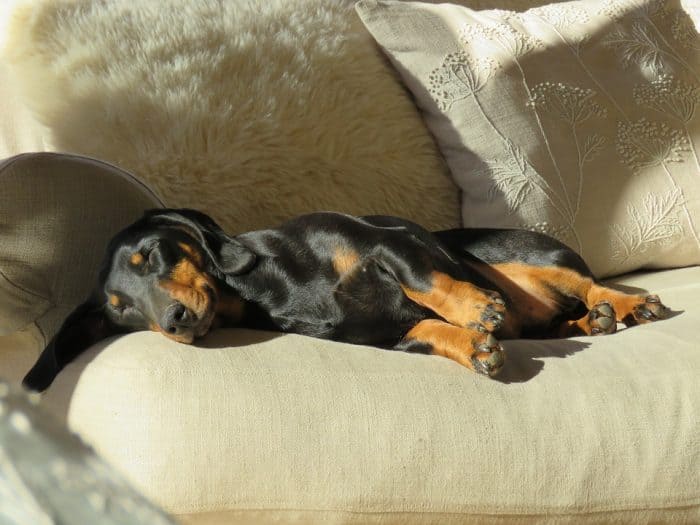
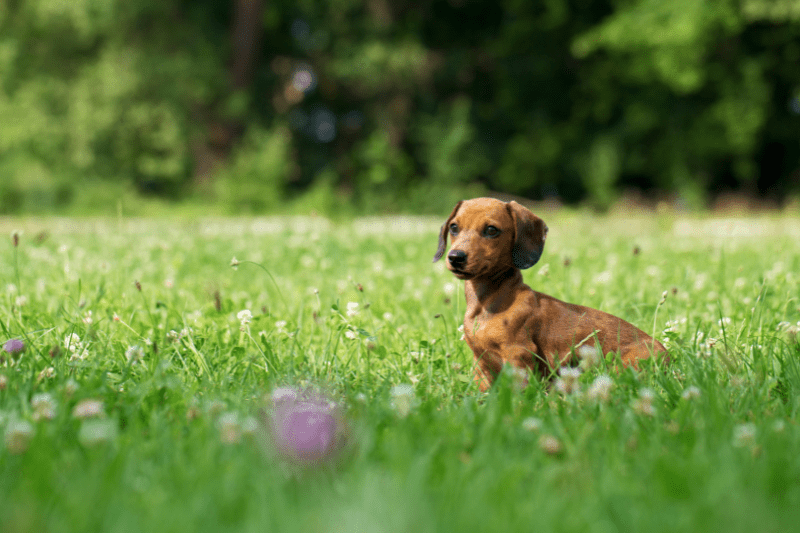
Think a Miniature Dachshund is small? Meet the Kaninchen — the smallest type of Dachshund in the world.
The Rabbit Dachshund (or “Kaninchen Dachshund,” from the German word for rabbit) is a tiny, agile little hound originally bred to chase rabbits into their tightest underground burrows. These petite Doxies tip the scales at just 7.7 pounds or less — making them noticeably smaller and more slender than the Miniatures most Americans are familiar with.
The catch? The American Kennel Club doesn’t formally recognize the Rabbit Dachshund as a separate size, while the European Fédération Cynologique Internationale (FCI) does. That international difference creates plenty of confusion among Doxie owners and prospective adopters.
This guide explains everything you need to know about the Kaninchen Dachshund: its history, size standards, temperament, recognition status, and what to expect if you’re considering adopting one. Whether you’re a curious Dachshund fan or actively shopping for the smallest of the small, you’ll find clear answers below.
What Is a Rabbit Dachshund?
A Rabbit Dachshund — also called a Kaninchen Dachshund (pronounced “kah-NEEN-chen”) — is the smallest of the three FCI-recognized Dachshund sizes. The German word Kaninchen literally means “rabbit,” and the dogs were named for their original purpose: chasing rabbits into their narrow underground burrows.
Key facts at a glance:
- Maximum weight: 7.7 lbs (3.5 kg)
- Chest circumference (males): 10.6–12.6 inches (27–32 cm)
- Chest circumference (females): 9.8–11.8 inches (25–30 cm)
- Recognized by: The Fédération Cynologique Internationale (FCI) — the body governing dog breeds across most of Europe and many other parts of the world
- NOT recognized by: The American Kennel Club (AKC) as a separate size
- In the U.S.: Registered as Miniature Dachshunds
Despite their tiny size, Rabbit Dachshunds are true working hounds with the same hunting drive, loud bark, and big personality as their larger Standard and Miniature cousins — just packaged in a much smaller body.
The Three Sizes of Dachshund
The Dachshund breed comes in three sizes, each historically bred for hunting different prey:
- Standard Dachshund — bred to hunt badgers, foxes, hare, and even wild boar (in packs). The original Dachshund.
- Miniature Dachshund — developed in the 1800s during a German rabbit-population boom for hunting smaller prey.
- Kaninchen (Rabbit) Dachshund — bred even smaller specifically to chase rabbits into their tightest burrows.
If you’ve ever wondered why Dachshunds vary so dramatically in size — from chunky 30-pounders to tiny 7-pound pups — this is why. They were never just companion dogs; each size was developed for a specific kind of underground hunting.
Related post: Standard Dachshund vs Miniature Dachshund

How Big Is a Rabbit Dachshund?
The Rabbit Dachshund’s size is officially measured by chest circumference — not weight or shoulder height — under FCI standards. The measurement is taken when the dog is at least 15 months old, since Dachshunds aren’t done growing before then.
| Measurement | Male Kaninchen | Female Kaninchen |
|---|---|---|
| Chest circumference | 10.6–12.6 in (27–32 cm) | 9.8–11.8 in (25–30 cm) |
| Maximum weight | 7.7 lbs (3.5 kg) | 7.7 lbs (3.5 kg) |
| Minimum age for measurement | 15 months | 15 months |
This chest-circumference standard exists because the original purpose of the Kaninchen was to fit through small, tight rabbit burrows — and a dog’s chest is the widest part of its body. If the chest fits, the rest of the dog will too.
Rabbit vs. Miniature vs. Standard: Side-by-Side
Here’s how all three Dachshund sizes compare under FCI standards:
| Size | Max Weight | Chest Circumference | Original Purpose | AKC Recognition |
|---|---|---|---|---|
| Standard | 16–32 lbs | 14+ in (35+ cm) | Badger, fox, boar | ✓ Yes |
| Miniature (FCI: “Dwarf”) | ~11 lbs | 12.2–14 in (31–35 cm) | Smaller game, rabbits | ✓ Yes (under 11 lbs) |
| Kaninchen (Rabbit) | ≤7.7 lbs | ≤12.6 in (≤32 cm) male; ≤11.8 in (≤30 cm) female | Rabbit burrow hunting | ✗ No — registered as Miniature |
The Kaninchen is roughly 30% smaller than a Miniature Dachshund and about half the size or less of a Standard. Holding a Kaninchen in your hands genuinely feels like holding a puppy — even when they’re full-grown adults.
AKC vs. FCI: Why the Recognition Difference?
The reason the Kaninchen exists in some countries but not others comes down to two different breed-classification systems:
The American Kennel Club (AKC)
The AKC uses weight and shoulder height to classify Dachshunds, recognizing only two sizes:
- Standard: 16–32 lbs
- Miniature: 11 lbs and under at 12 months
Under AKC rules, a 7-pound Kaninchen-sized dog is simply registered as a Miniature.
The Fédération Cynologique Internationale (FCI)
The FCI — which governs breed standards across most of Europe, Asia, South America, and Africa — uses chest circumference measured at 15 months of age, recognizing three sizes:
- Standard (Normalgrösse)
- Miniature/Dwarf (Zwergteckel)
- Rabbit/Kaninchen (Kaninchenteckel)
So a “Rabbit Dachshund” in Germany is genuinely a different size category. In the U.S., that same dog would just be called a small Miniature.

Origins & History of the Kaninchen
The Kaninchen Dachshund is the youngest of the three sizes — and its origin story is rooted in a very specific 19th-century problem: rabbits.
In the 1800s, Germany experienced a dramatic rabbit population boom. Rabbits were doing significant damage to farmland and forests, and farmers needed dogs that could chase them into their narrow burrows — burrows that were too tight even for the existing Miniature Dachshunds.
The solution was selective breeding. Breeders took the smallest Miniature Dachshunds and bred them together over generations, gradually producing dogs small enough to fit into the tightest rabbit holes. By the late 19th and early 20th century, this even smaller variety became formally distinguished from regular Miniatures and earned its own name: Kaninchenteckel, or “Rabbit Dachshund.”
Today, the Kaninchen is more of a hunting and tradition heritage in Germany than an actual working rabbit hunter, but the size category remains officially preserved by the FCI.
Appearance, Coats & Colors
Apart from their smaller size, Rabbit Dachshunds look essentially identical to their Standard and Miniature cousins — same iconic long body, same short legs, same expressive face.
Like the larger Dachshund varieties, they come in all three coat types:
- Smooth-haired: Short, sleek, and shiny — the classic Doxie look
- Long-haired: Silky, slightly wavy fur with feathering on the ears, chest, legs, and tail
- Wire-haired: Thick, coarse outer coat with the iconic beard and eyebrows
And in all the same colors and patterns:
- Red, cream, black & tan, chocolate & tan, blue & tan, isabella & tan, wild boar
- Patterns: Piebald, brindle, dapple, sable
Rabbit Dachshunds tend to look a bit more “delicate” or “refined” than larger Dachshunds — slightly more slender bones, slightly finer features. Many owners say they retain a puppy-like look well into adulthood thanks to their tiny stature.
Temperament & Personality
Don’t let their tiny size fool you — Kaninchen Dachshunds have full-sized Dachshund personalities. They’re the same bold, stubborn, devoted, mischievous little hunters as their larger cousins, just in a more portable package.
Typical Rabbit Dachshund personality traits:
- Bold and fearless — will face down dogs many times their size
- Highly active and alert — surprisingly energetic for such a tiny dog
- Loyal to their human — often forming an especially intense bond with one person
- Stubborn and independent — hunting heritage means they’ll challenge your training
- Vocal — they bark, and their bark is loud for their size
- Affectionate — love to cuddle and be close to their humans
- Playful and clever — great problem-solvers who need mental stimulation
They generally get along well with other dogs and cats when properly socialized, especially if raised together. However, their hunting instincts can be strong — small pets like hamsters, gerbils, or pet rabbits may not be safe around them given their original purpose.
Exercise & Care Needs
Despite their petite size, Rabbit Dachshunds need real exercise. Don’t fall into the trap of thinking a tiny dog can get all their activity from running around the house.
Daily Exercise Guidelines
- Daily walks: 20–30 minutes, split across two outings
- Mental stimulation: Puzzle toys, scent games, basic training
- Indoor play: Fetch, hide-and-seek, gentle wrestling
- Sniff time: Let them lead with their nose — incredibly satisfying for hounds
Back-Safe Care
Like all Dachshunds, Rabbit Dachshunds are at high risk for Intervertebral Disc Disease (IVDD). Their tiny size doesn’t protect them — it actually makes them more delicate. Always:
- Lift them with both hands, supporting chest and hindquarters
- Use ramps for couches and beds
- Avoid stairs whenever possible
- Use a harness, never a neck collar
- Keep their weight in the lean range
Because they’re so small, even a single jump from the couch or being stepped on can cause serious injury. Households with young children or larger dogs need to be especially careful.
Health Considerations
Rabbit Dachshunds share most health concerns with the larger Dachshund varieties, but their tiny size adds a few unique considerations.
Common Dachshund Health Issues
- Intervertebral Disc Disease (IVDD) — the #1 health concern for any Dachshund
- Patellar luxation — kneecap dislocation, more common in tiny breeds
- Dental disease — small mouths often have crowded teeth
- Ear infections — long droopy ears trap moisture
- Eye conditions — including progressive retinal atrophy (PRA)
- Obesity — even small amounts of extra weight strain their tiny frame
Tiny-Dog Specific Concerns
- Hypoglycemia (low blood sugar) — small dogs can develop dangerously low blood sugar more quickly than larger dogs
- Tracheal collapse — small windpipes are more vulnerable
- Cold sensitivity — they lose body heat fast; sweaters often necessary
- Injury from falls — even short falls can cause fractures or back injury
The expected lifespan of a Rabbit Dachshund is 12–16 years, similar to other Dachshund varieties. With proper care, they can live long, healthy lives.

How to Tell If Your Dachshund Is a Kaninchen
If you live in the U.S. and your Dachshund seems unusually small, you might have a true Kaninchen on your hands (even though they’re registered as a Miniature on paper).
To find out, take these measurements when your Dachshund is at least 15 months old:
- Weigh your dog accurately. If they’re 7.7 lbs (3.5 kg) or under at full adult weight, they meet the Kaninchen weight standard.
- Measure chest circumference. Use a flexible measuring tape around the widest point of the chest, just behind the front legs. Use the FCI numbers above (≤12.6 inches for males, ≤11.8 inches for females).
- Confirm both criteria. Both weight AND chest measurement should fall within the Kaninchen range.
If your Dachshund qualifies, they’re technically a Kaninchen even though American paperwork calls them a Miniature. Some breeders specifically advertise “Kaninchen” puppies in the U.S. — these are typically Miniatures bred from very small parents.
Important: Don’t confuse a Kaninchen with a “teacup” Dachshund. “Teacup” is a marketing term, not a recognized size — and dogs sold as teacups are often genuinely undersized due to poor breeding practices, with serious associated health problems. A true Kaninchen is bred to a recognized FCI standard from healthy parent stock.
Where Are Rabbit Dachshunds Most Popular?
The Rabbit Dachshund is most popular in Germany, where they originated and remain part of the country’s hunting and breeding tradition. The German Teckel Club (DTK) maintains strict standards for the Kaninchen size and supports the breed’s working heritage.
Other regions with strong Kaninchen popularity include:
- Other German-speaking countries — Austria, Switzerland
- Continental Europe — France, Italy, the Netherlands
- Eastern Europe — strong working-Dachshund traditions
- South America — Brazil and Argentina have notable Kaninchen breeding
- Japan — small dogs are extremely popular and Kaninchens are well-loved
In the United States, the Kaninchen is gaining recognition — especially among Dachshund enthusiasts shopping for very small Doxies — but they’re still registered as Miniatures by the AKC. Some U.S. breeders specifically focus on Kaninchen-sized lines and import dogs from FCI-recognized European bloodlines.
Is a Rabbit Dachshund Right for You?
Rabbit Dachshunds make wonderful companions for the right household — but they’re not for everyone. Here’s an honest assessment.
A Rabbit Dachshund Might Be Right For You If:
- You love small dogs and want the smallest possible Dachshund
- You live in an apartment or smaller home (they don’t need much space)
- You can offer plenty of human company (they hate being alone)
- You have time for daily walks and mental stimulation
- You’re prepared to be careful about back safety, falls, and injuries
- You don’t have very young children who could accidentally hurt them
- You’re patient with their stubborn streak during training
A Rabbit Dachshund Might NOT Be Right For You If:
- You have small pets like rabbits, hamsters, or guinea pigs (hunting drive)
- You have very young or rambunctious children
- You have large, energetic dogs that play rough
- You’re often away from home for long hours
- You expect a quiet dog (Dachshunds bark a lot)
- You can’t commit to back-safe practices (no jumping, no stairs, harness only)
- Your budget can’t comfortably absorb potential IVDD-related vet bills
Related post: Are Miniature Dachshunds Good Pets?
Frequently Asked Questions
What is the smallest type of Dachshund?
The Kaninchen Dachshund (Rabbit Dachshund) is the smallest type, weighing 7.7 pounds or less and measuring 12.6 inches or less in chest circumference. It’s recognized by the FCI but not by the AKC, which classifies all small Dachshunds as Miniatures.
Is a Kaninchen the same as a Miniature Dachshund?
No, they’re technically different sizes under FCI standards. The Kaninchen is smaller (max 7.7 lbs and chest under 12.6 inches), while the Miniature can be up to 11 lbs. In the U.S., however, both fall under the AKC’s Miniature category.
Why doesn’t the AKC recognize Rabbit Dachshunds?
The AKC simply uses a different two-size classification system based on weight and shoulder height, while the FCI uses chest circumference and recognizes three sizes. It’s not that the Kaninchen doesn’t exist in the U.S. — it’s just registered as a small Miniature.
How much does a Rabbit Dachshund weigh?
A full-grown Rabbit Dachshund weighs 7.7 pounds (3.5 kg) or less. They’re considerably smaller than Miniature Dachshunds, which can be up to 11 pounds.
Are Rabbit Dachshunds healthy?
Generally yes, but they share the Dachshund breed’s susceptibility to IVDD (back problems), and their tiny size adds risks like patellar luxation, hypoglycemia, and injury from falls. With responsible breeding and proper care, Kaninchens can live healthy 12–16 year lives.
Are Rabbit Dachshunds good with kids?
They can be, but their tiny size makes them fragile around young children. They’re generally better suited to homes with older, gentle kids who understand how to handle small dogs carefully.
How do I find a Rabbit Dachshund in the U.S.?
Look for breeders who specifically advertise Kaninchen-sized lines, ideally with FCI-imported parent dogs. Verify health testing and ethical breeding practices. Avoid “teacup” listings — those are usually unhealthy undersized dogs from poor breeding, not true Kaninchens.
Are Rabbit Dachshunds expensive?
Expect to pay $2,000–$4,000+ for a well-bred Kaninchen Dachshund in the U.S., often more for imported European-line puppies. Adoption from breed-specific rescues is more affordable when available.
Do Rabbit Dachshunds bark a lot?
Yes. Despite their small size, Rabbit Dachshunds have a surprisingly loud bark — a trait bred into them so hunters could locate them when they were working underground. Apartment dwellers should be aware of this.
Can a Rabbit Dachshund still hunt?
In Germany, yes — there are still working Kaninchens used for rabbit hunting and tracking. In most of the world, however, they’re kept as companion pets and exhibit their hunting traits only through chasing squirrels, digging in blankets, and the occasional indignant bark at the mailman.
Final Thoughts: Big Personality in a Tiny Package
The Rabbit Dachshund — or Kaninchen — is one of the most charming and overlooked members of the Dachshund family. They pack centuries of hunting heritage, fierce loyalty, and full-sized Dachshund personality into a body that fits comfortably in your lap.
The AKC may not officially recognize them as a separate size, but their international fan base and the FCI’s continued recognition prove the Kaninchen has earned its place. Whether you’re a serious Dachshund collector hunting for the smallest of the small, an apartment dweller looking for a portable companion, or simply a Doxie lover who fell in love with the idea of a tiny version of the breed — the Kaninchen is well worth knowing about.
Just remember: small body, big needs. Like all Dachshunds, Rabbit Dachshunds need careful spinal care, proper exercise, mental stimulation, and a serious investment of human attention. Get those right, and you’ll have an utterly devoted little hound who fits in your hand and lives in your heart for years to come.
Related post: Types of Dachshunds: Sizes, Coats, and Colors
Disclaimer: This article is for informational purposes only. Breed standards differ between registries; for the most current and accurate breed standards, consult the AKC, FCI, or German Teckel Club directly. If you’re considering adopting a Rabbit Dachshund, work only with reputable breeders who prioritize health and ethical breeding practices.