
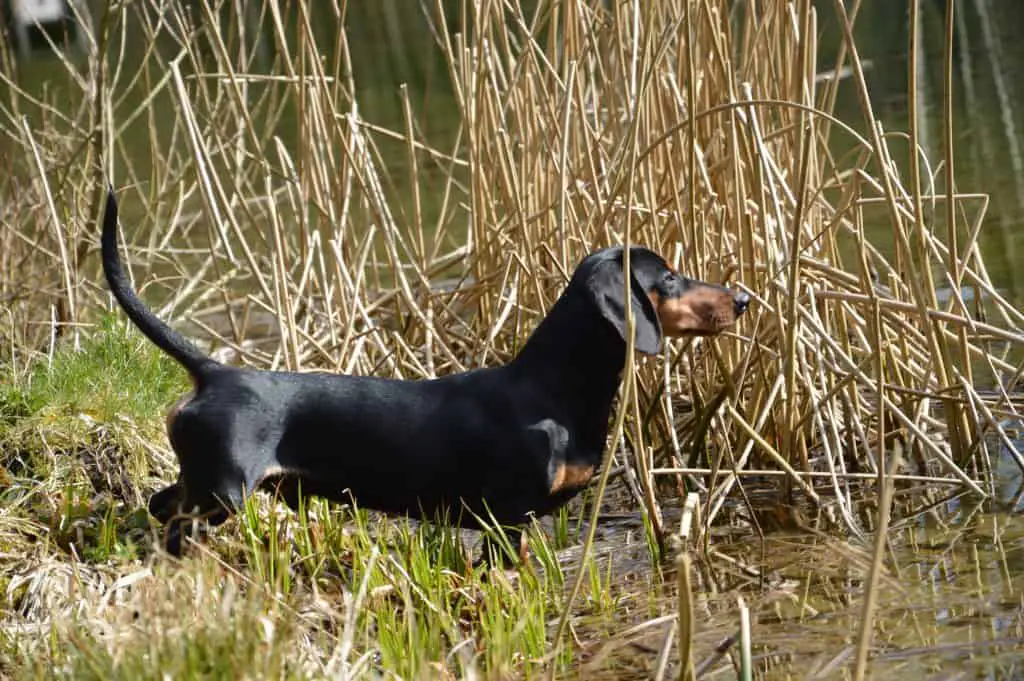
Look at a Dachshund’s long, low body and short, sturdy legs and you’ll see something incredible: a dog purpose-built for one specific job.
Today’s Dachshunds may spend their days chasing squirrels, snuggling under blankets, and barking at the doorbell — but every quirk of their unusual silhouette traces back to the same answer to one question: what were Dachshunds bred for?
The short answer: Dachshunds were bred to hunt badgers underground in 17th-century Germany. The long answer is a centuries-old story of selective breeding, royal patronage, and the rabbit-population boom that gave us the Miniature Dachshund. Let’s dive in.
Quick Answer: What Were Dachshunds Bred For?
Dachshunds were bred to hunt badgers — and to a lesser extent foxes, wild boar, hare, and rabbits — by tracking them above ground and then following them straight into their underground burrows. The breed was developed in Germany starting in the 1600s and refined over the next two centuries into the dogs we know today.
Their famous body shape — long spine, short legs, deep chest, loose skin, loud bark, curved tail — wasn’t an accident. Every single physical trait was selected by German hunters to make the dog more effective at “earth-dog” work: tunneling underground after dangerous prey and engaging it in close combat.
Related post: The History and Origins of the Dachshund
What “Dachshund” Means in German
The breed’s name is the clearest hint at its original purpose. “Dachshund” is a German compound word:
- Dachs — meaning “badger”
- Hund — meaning “dog” or “hound”
Put together: badger dog. The name doesn’t describe the dog’s appearance — it describes the dog’s job. And that job was no joke. European badgers are powerful, fearless, ferocious animals weighing up to 40 pounds, with sharp claws and crushing jaws. Hunting them required a dog with extraordinary courage, tenacity, and a body shape that could go places no other dog could.
Today, Germans more commonly call the breed Dackel or Teckel — the latter being especially common among hunters and breeders of working Dachshunds.

What Were Dachshunds Originally Used For?
The Dachshund’s primary job was clear: force prey out of underground burrows. According to the American Kennel Club, the typical hunt went like this:
- Track the prey above ground using their powerful nose
- Follow the scent into the burrow opening
- Squeeze underground using their long, slim body
- Engage the badger directly — sometimes a fight to the death
- Bark loudly so hunters could pinpoint their underground location
- Hold the prey until hunters could dig down to assist
This wasn’t gentle work. Badgers, foxes, and other burrow-dwellers fought back fiercely. Dachshunds were essentially canine “earth warriors” — small enough to fit in tunnels, but tough enough to take on prey their own size or larger.
Beyond badgers, Dachshunds were used to hunt:
- Foxes — both above and below ground
- Hare and rabbits — chasing them out of dens or warrens
- Wild boar — typically in packs (yes, really)
- Wounded deer — tracking blood trails through dense forest
The Dachshund’s range of prey is what made them so beloved among German foresters: a single dog could handle multiple types of game, from underground badger battles to above-ground tracking of much larger animals.
Related post: Why Are Dachshunds So Long?
Standard vs. Miniature Dachshunds: Two Hunting Roles
The Dachshund breed comes in two sizes — and each was developed for a specific kind of prey:
| Type | Original Prey | Modern Weight | Hunting Role |
|---|---|---|---|
| Standard Dachshund | Badgers, wild boar, foxes, hare | 16–32 lbs | Heavy-duty earth dog and game tracker |
| Miniature Dachshund | Rabbits, ferrets, smaller burrow-dwellers | Under 11 lbs | Agile small-game hunter |
The Standard Dachshund Came First
The original Dachshund was a Standard, developed for the formidable badger. The original 17th and 18th-century dogs were even larger than today’s Standards, weighing 31–40 pounds and built like compact tanks.
The Miniature Was Created for the Rabbit Boom
In the 1800s, Germany experienced a massive surge in rabbit populations — and farmers needed a dog small enough to follow them into their narrower burrows. Breeders responded by selectively breeding the smallest Dachshunds together, eventually producing the Miniature Dachshund (under 11 pounds).
An even smaller variant, the Kaninchen (“rabbit dog”) at under 7.7 pounds, was developed for the very tightest burrows. The Kaninchen is recognized by European registries but classified as a Miniature in the U.S.
Why Dachshunds Have Such a Unique Body Shape
Almost everything that makes a Dachshund look like a Dachshund was bred in for a specific hunting reason. Let’s break down the design — feature by feature.
Short Legs: For Squeezing Into Burrows
Dachshunds’ short, sturdy legs are the defining feature of the breed — and the most important hunting adaptation. Their stubby legs allowed them to:
- Enter burrow openings too tight for normal-sized dogs
- Move efficiently through underground tunnels
- Change direction quickly when chasing fast, agile prey like rabbits
- Dig effectively — those short, powerful front legs are surprisingly strong shovels
This trait comes from a genetic condition called chondrodystrophy, which produces shortened limbs. While it gave Dachshunds their iconic shape, it also makes them more prone to disc problems — which is why proper care of their spine matters so much today.
Long Body: For Maneuvering Underground
The Dachshund’s elongated body wasn’t just style — it was function. A long, slim body allows the dog to:
- Fit through narrow tunnels with minimal squeezing
- Twist and turn in tight underground spaces
- Extend reach when grabbing prey with their teeth
- Move flexibly like a snake when needed
The trade-off, of course, is that long backs are mechanically vulnerable — which is why Dachshunds are highly prone to Intervertebral Disc Disease (IVDD). Their working ancestors lived dangerous lives; modern Doxies need our help avoiding back injury.
Deep Chest: For Stamina and Lung Capacity
Look at a Dachshund from the side and you’ll notice their chest extends remarkably deep — almost to ground level. This isn’t decorative. A deep chest provides:
- Larger lung capacity for sustained activity
- More heart space for endurance work
- Better stamina on long tracking runs
The deep chest gave Dachshunds the cardiovascular tools to track game over miles of forest before going underground for the kill.
Floppy Ears: For Protection in Burrows
Those iconic long, droopy ears served a very practical purpose: they covered and protected the ear canal when the dog was working underground. Long ears prevented:
- Dirt and debris from entering the ear canal
- Insects and parasites from getting inside
- Injury from sharp roots or stones in tunnels
The downside? Modern Dachshunds with their iconic floppy ears are more prone to ear infections, since the same shape that protected against debris also limits airflow to the canal. Regular ear checks are a must.
Curved Tail: A Built-In Handle
The Dachshund’s slightly curved, often upright tail isn’t just charming — it served two practical hunting purposes:
- Visibility flag. Hunters needed to see where their dogs were in tall grass and underbrush — that upright tail was a beacon.
- Emergency handle. When a Dachshund got stuck deep in a burrow, hunters would literally pull them out by the tail. The strong, curved tail was specifically bred to be sturdy enough to withstand pulling.
(Modern owners: don’t try this. We have leashes now.)
Loud Bark: For Underground Communication
Dachshunds are famous for their surprisingly deep, loud bark — disproportionately powerful for a dog so small. There’s a great reason for that.
When a Dachshund went underground, the hunter couldn’t see them. The dog needed to continuously alert the hunter to its location, and the only way to do that through several feet of soil was with a deep, sustained, carrying bark. The loud bark helped hunters:
- Track the dog’s progress through the tunnel
- Know when prey was cornered
- Locate the dog if it got stuck
- Decide where to dig down for assistance
That same loud bark is now what alerts you to every Amazon delivery. Sorry.
Loose Skin: Armor Against Bites
Dachshunds have noticeably loose, somewhat thick skin compared to most breeds. This wasn’t a quirk — it was combat protection:
- Loose skin slides over muscle and bone, deflecting bites and reducing damage
- Tough skin protected against tunnel scrapes and root abrasions
- Bridge bone above the eyes — a thicker bone ridge that protected the eyes during head-on confrontations with prey
- Strong jaws and large teeth for combat with formidable badgers
Picture a Dachshund grabbing a 30-pound badger by the neck in a dark tunnel — that’s what this dog was built for.
Why There Are Three Coat Types
Dachshunds come in three distinct coat varieties — and each one was developed to suit different hunting environments and weather conditions:
Smooth-Haired Dachshund
The original Dachshund coat. Smooth coats were ideal for working in normal weather and didn’t catch on roots or debris in burrows. This is the breed’s foundational coat type.
Longhaired Dachshund
Developed by crossing smooth Dachshunds with various spaniel breeds. The longer coat provided better insulation for hunting in colder regions and snowy terrain, and the slightly gentler spaniel-influenced temperament made these dogs popular for retrieving game from water.
Wirehaired Dachshund
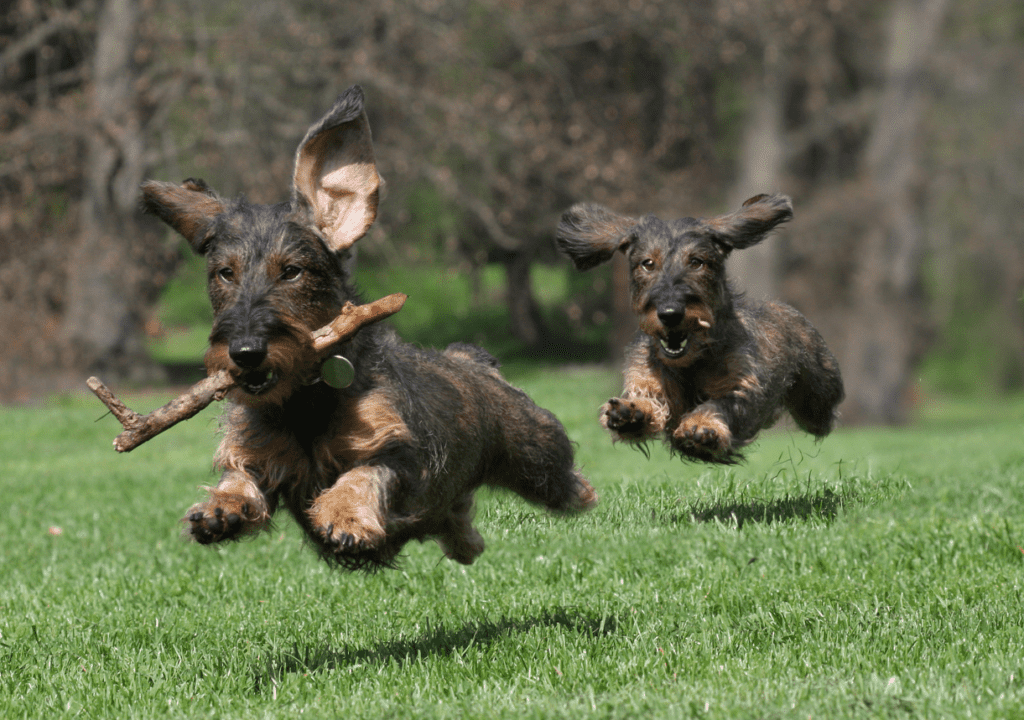
The newest of the three, developed in the late 1800s. Smooth Dachshunds were crossed with wire-coated terriers and Schnauzers to create a coat that could withstand thorny brush, brambles, and rough terrain. The terrier ancestry also gave wirehaired Dachshunds their signature mischievous, “clownish” personality.
How Hunting Heritage Shapes Modern Dachshund Personality
That centuries-old hunting purpose didn’t disappear when Dachshunds moved into our living rooms — it just transferred to squirrels, mailmen, and toys. Here’s how their hunting genes still show up every day:
| Hunting Trait | How It Shows Up Today |
|---|---|
| Independent decision-making (essential for working alone underground) | Famous Doxie stubbornness during training |
| Bold fearlessness (needed to face badgers) | Will challenge dogs 10x their size at the dog park |
| Strong prey drive | Squirrel obsession, intense focus on small moving things |
| Powerful nose | Loves sniffing on walks, can find treats anywhere |
| Digging instinct | Excavating in your yard, blankets, and couch cushions |
| Loud bark | Alerts you to every passing leaf, vehicle, and footstep |
| Tenacity | Won’t let go of a toy, a smell, or a goal |
| Pack-oriented loyalty | Strong bond with their favorite person |
Understanding that your Dachshund’s “annoying” traits are actually hardwired hunting instincts — refined over 400 years of intentional breeding — helps you appreciate them rather than fight them. The squirrel chasing isn’t bad behavior. It’s the breed working as designed.
Are Dachshunds Still Used for Hunting Today?
Yes — though most Dachshunds today are companions, the breed’s working tradition is very much alive in some parts of the world.
In Germany
Dedicated jagdliche Leistungszucht (“hunting performance breeding”) kennels still produce working Dachshunds for tracking and earth-dog work. These dogs are tested on formal hunting performance trials before being used for breeding, ensuring the working traits remain strong. The German hunting Dachshund tradition is a respected and protected aspect of the country’s outdoor culture.
In the United States
The AKC sanctions Earthdog trials — competitive events that test a Dachshund’s instinct to follow scent into underground tunnels and “work” caged rats (which are not harmed). Many American Dachshunds participate in these as a fun way to exercise their genetic skills. The AKC also offers Tracking and Field Trial events open to Dachshunds.
In Other Countries
Dachshunds are used for blood-tracking wounded game (deer, boar) in many European hunting communities — their powerful nose and tenacity make them ideal for finding shot animals that have escaped into dense terrain.
Related post: Are Dachshunds Hunting Dogs?

From Hunters to Household Pets: The American Story
Dachshunds officially became part of American canine history in 1885, when the American Kennel Club recognized the breed. The Dachshund Club of America followed in 1895.
The breed’s American journey hasn’t been smooth, though:
- Late 1800s: Dachshunds arrive with German immigrants and quickly catch on as companion animals.
- 1930s: Dachshunds become genuinely popular in America — but as household pets, not hunters. American owners largely lost the working tradition.
- World War I & II: Anti-German sentiment caused Dachshund popularity to plummet. Many Americans stopped owning them; some breeders renamed them “liberty hounds” or “badger dogs” to deflect prejudice. Owners reported their dogs being attacked in the streets.
- Post-1945: Popularity rebounds. Dachshunds quickly resume their place as one of America’s most beloved breeds.
- 1972: Waldi the Dachshund becomes the official mascot of the Munich Olympics — the first official mascot in modern Olympic history — symbolically reclaiming the breed’s German cultural heritage.
- Today: Dachshunds consistently rank in the AKC’s top 10 most popular breeds in the United States.
Most American Dachshunds today are companion animals through and through, though their hunting instincts remain alive in every squirrel chase, every backyard dig, and every defensive bark at the doorbell.
Frequently Asked Questions
What were Dachshunds originally bred to hunt?
Badgers, primarily. The name “Dachshund” literally means “badger dog” in German. They were also used to hunt foxes, rabbits, hare, wild boar (in packs), and to track wounded deer.
Why do Dachshunds have short legs?
Their short legs were deliberately bred to allow them to enter underground burrows too narrow for normal-sized dogs. Short legs also help them change direction quickly when chasing fast prey like rabbits.
Are Dachshunds still used for hunting?
Yes, especially in Germany and other European countries, where dedicated working Dachshunds are still bred and used for badger, fox, and blood-tracking work. In the U.S., AKC Earthdog trials let Dachshunds use their hunting instincts in a competitive sport setting.
Why are Miniature Dachshunds smaller than Standards?
Miniature Dachshunds were specifically bred in the 1800s to hunt rabbits and smaller animals with narrower burrows than badger dens. Their smaller size made them more agile and able to follow rabbits into tighter spaces.
What does “Dachshund” mean?
It’s a German compound word: Dachs (“badger”) + Hund (“dog or hound”) — literally “badger dog.” In modern Germany, the breed is more commonly called Dackel or Teckel.
Why are Dachshunds so stubborn?
Their stubbornness is a hunting trait. Working underground meant Dachshunds had to make independent decisions without human direction — that genetic independence shows up today as that famous Doxie stubborn streak during training.
Do all Dachshunds have hunting instincts?
Yes — even the laziest couch-Doxie has hunting genes baked in. You’ll see them in prey drive (chasing squirrels, birds, leaves), digging, sniffing intensely on walks, and the loud “alert” bark.
Why do Dachshunds bark so much?
Their loud, deep bark was specifically bred so hunters could locate them underground. That same trait now alerts you to mailmen, doorbells, neighbors, and anything moving outside your window.
Were Dachshunds bred to be lap dogs?
No. Dachshunds belong to the AKC’s Hound Group and were bred entirely for hunting, not companionship. That said, they’ve become some of the most cuddly and devoted lap-loving companions imaginable — but the hunting heritage came first.
Final Thoughts: A Hunter at Heart
The next time you watch your Dachshund chase a squirrel up a tree, dig under your couch cushions, or bark furiously at a leaf blowing across the yard, take a moment to appreciate what you’re seeing.
You’re not just looking at a quirky little dog with funny short legs. You’re looking at the descendant of a specialized German working breed — a dog so deliberately engineered for badger hunting that nearly every quirk of its body and personality traces directly back to that purpose. Three hundred years ago, this exact dog was diving headfirst into dark underground tunnels to fight prey twice its size. Today, it does the same thing, just with toys and rolled-up socks instead.
The Dachshund is living proof that form follows function — and that even a dog bred for the toughest of hunting jobs can become one of the most loving, loyal, and ridiculous companions a human could ask for.
So embrace the squirrel chasing. Enjoy the tunnel-digging in the blankets. Laugh at the deep, indignant bark at every passing pedestrian. Your Doxie isn’t being weird — they’re being a Dachshund, exactly as their ancestors were bred to be.
Disclaimer: This article is for informational purposes only. Historical accounts of breed development can vary among sources; the history presented here draws on widely accepted accounts from the AKC, the Dachshund Club of America, and other recognized breed authorities.
