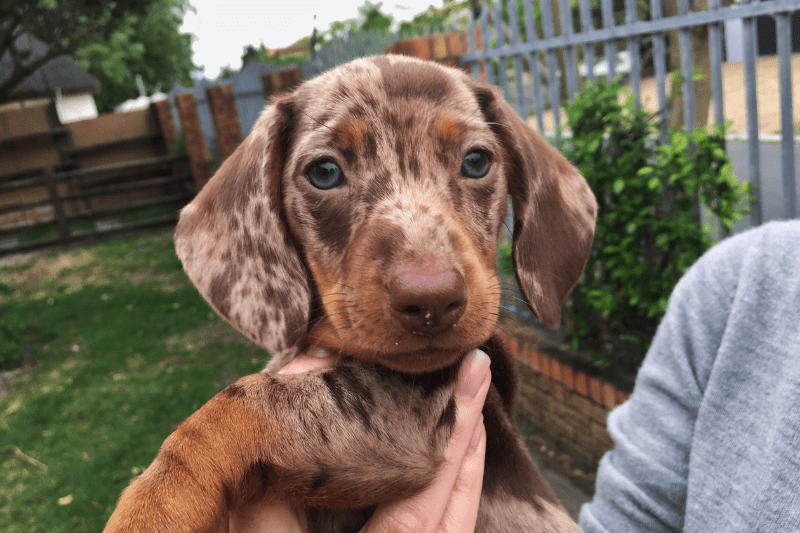
Merle Dachshunds are some of the most visually striking dogs in the world. Their swirled, mottled coats and often-blue eyes give them a one-of-a-kind appearance that turns heads at every dog park.
But there’s a lot more to know about the merle pattern than just how it looks. Merle is governed by a complex dominant gene with significant health implications, and many would-be merle owners are confused about what merle even is (it’s actually the same thing as “dapple” in Dachshund terminology), how it’s inherited, why some merle breeding practices are dangerous, and what to look for in a healthy merle puppy.
This complete guide covers everything: what makes a Dachshund “merle,” the genetics behind the pattern, the critical difference between safe single merles and dangerous double merles, important health considerations, how to find an ethical breeder, and what to expect when bringing a merle Doxie into your life.
Affiliate disclosure: This post contains a few Amazon affiliate links. If you click through and make a purchase, we may earn a small commission at no extra cost to you. We only recommend products we believe in — and your support helps keep Dachshund Central running. Thank you!
What Is a Merle Dachshund?
A Merle Dachshund is a Dachshund with a coat pattern called “merle” — a mottled, marbled, or “splashed” appearance where patches of normal pigmentation appear within areas of diluted color. The effect looks almost like watercolor blending on the coat, with random spots, swirls, or marbled patterns of one shade within another.
Key characteristics of a merle Dachshund:
- Mottled or marbled coat pattern rather than solid color
- Random patches of darker pigment within lighter “diluted” areas of the same color family
- Often striking eye colors — including blue eyes or “split eyes” (heterochromia)
- Sometimes pink/spotted nose or pink areas around eyes and mouth
- No two merles look identical — patterns are completely unique
Merle vs. Dapple: Same Thing, Different Names
Here’s something that confuses many Dachshund owners: in the Dachshund world, “merle” and “dapple” refer to the exact same coat pattern and genetics.
- “Dapple” is the traditional term used by the American Kennel Club and the Dachshund Club of America in their breed standards.
- “Merle” is the term used in other breeds (Australian Shepherds, Collies, Great Danes, etc.) for the same pattern caused by the same gene.
- Both come from the same dominant gene — the PMEL (also called SILV) gene
So a “merle Dachshund” and a “dapple Dachshund” are the same dog under different names. Some breeders use “merle” because it sounds more dramatic or rare, but technically the proper Dachshund breed-standard term is “dapple.”
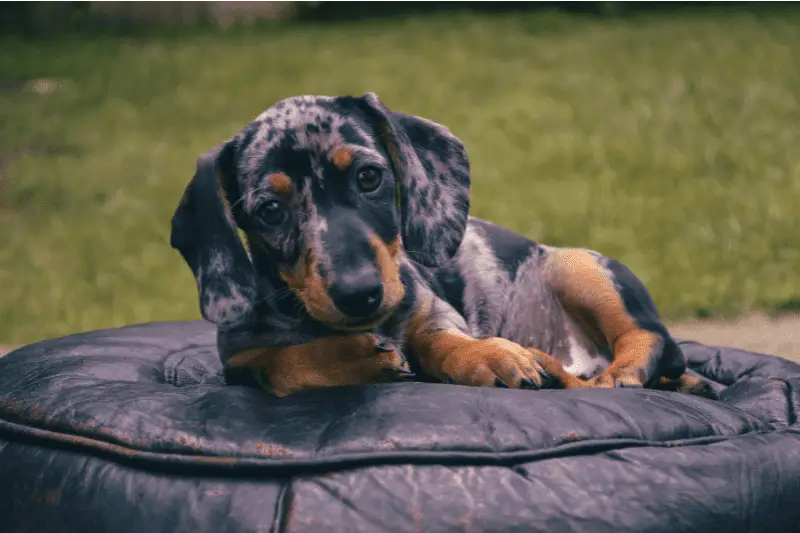
What Does a Merle Dachshund Look Like?
The merle pattern is unmistakable once you’ve seen it. Unlike a piebald (which has clear blocks of solid color on a white base), a merle’s pattern looks swirled and integrated.
Typical merle visual features:
- Diluted base coat — usually a lighter version of the dog’s actual color
- Random darker patches scattered throughout
- “Marbled” appearance rather than crisp edges
- Possible blue eye(s) — one or both eyes may be blue, partially blue, or “split”
- Pink or mottled nose in some merles
- Pink skin patches in some areas (visible especially in smooth coats)
The amount of mottling varies dramatically from dog to dog. Some merles have heavy, dramatic patterning; others have subtle marbling that’s only visible up close.
The Genetics of Merle — Why It’s Important to Understand
This is the most important section to read carefully — getting the genetics right is the difference between a healthy puppy and one with serious lifelong health issues.
Merle Is a Dominant Gene
The merle pattern is caused by a dominant gene on the PMEL gene locus. Geneticists denote it like this:
- M = merle allele (dominant)
- m = non-merle allele (recessive)
- Mm = merle dog (one copy of the merle gene)
- mm = non-merle dog
- MM = “double merle” dog (two copies — this is the dangerous combination)
Because merle is dominant, a dog only needs one copy of the gene to display the merle pattern. This is fundamentally different from recessive patterns like piebald, where both parents must carry the gene.
How Merle Is Inherited
Here’s how merle inheritance works in breeding:
| Parent 1 | Parent 2 | Likely Puppy Outcome | Safe? |
|---|---|---|---|
| Merle (Mm) | Non-merle (mm) | ~50% merle, ~50% non-merle — all healthy | ✓ SAFE |
| Non-merle (mm) | Non-merle (mm) | 100% non-merle, all healthy | ✓ SAFE |
| Merle (Mm) | Merle (Mm) | ~25% non-merle, ~50% merle, ~25% DOUBLE MERLE | ✗ DANGEROUS — DO NOT DO |
The correct way to produce merle Dachshund puppies is to breed one merle parent (Mm) with one non-merle parent (mm). This produces a healthy mix of merle and non-merle puppies with no risk of double merle.
(Note: some online sources incorrectly describe merle as recessive — this is wrong. The dominant nature of the gene is precisely why breeding two merles together is so dangerous.)

The Double Merle Problem (Critical Section)
Breeding two merle Dachshunds together produces puppies with two copies of the merle gene — known as “double merles” (or in Dachshund-speak, “double dapples”). According to the Dachshund Club of America’s official guidance on color inheritance, this breeding practice is strongly discouraged due to the severe health problems associated with double merle puppies.
Health Problems in Double Merles
Approximately 25% of puppies from two merle parents will be double merles, and many of them suffer from devastating health issues:
- Congenital deafness — often complete deafness in one or both ears
- Blindness — partial or complete
- Microphthalmia — abnormally small or missing eyes
- Other eye deformities — including starburst pupils, missing parts of the iris
- Mostly white coat with very little pigmentation
- Sometimes life-threatening defects in extreme cases
The reason: the merle gene affects pigment-producing cells (melanocytes) that are also involved in the development of the inner ear and eye structures. One copy of the gene generally has only minor effects, but two copies cause major developmental problems.
Why Some Breeders Still Do It
Some unethical breeders intentionally breed two merles together because double merles look unusual and can be sold at high prices to buyers who don’t know any better. This is one of the most exploitative practices in the dog breeding world. The dogs that result often face lifelong sensory disabilities and may require extensive special care.
How to Avoid Buying a Double Merle
- Never buy from a breeder who breeds merle to merle. Ask explicitly about the parents.
- Ask for DNA test results on both parents.
- Verify with the breed club if you have any doubts.
- Be wary of “all-white” or “mostly white” merle puppies — these are likely double merles.
- Be wary of “double dapple” listings — these are explicitly double merles.
- Get BAER (hearing) tests performed before purchase.
If you do end up adopting or rescuing a double merle Dachshund, know that they can still live happy, fulfilling lives — they just need extra support and accommodations. But never financially reward a breeder who intentionally produces them.
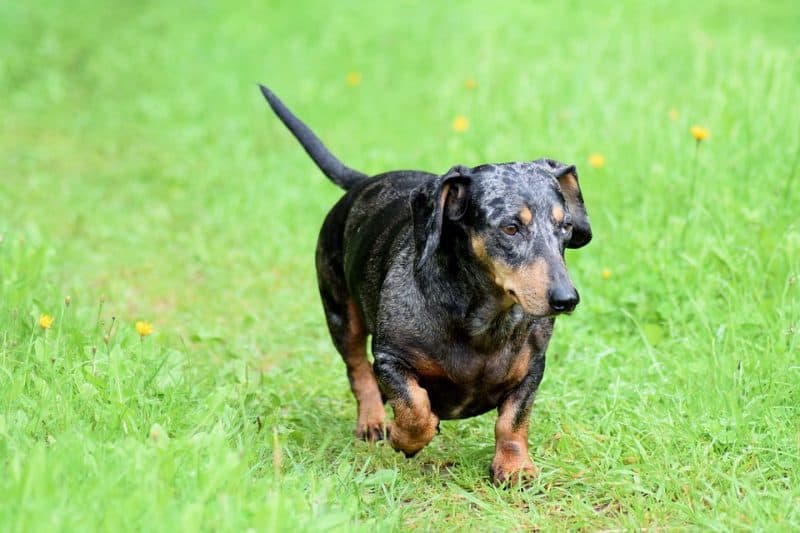
Common Merle Color Combinations
The merle pattern overlays on whatever base color the Dachshund would otherwise be. Common merle combinations include:
- Blue merle (silver dapple) — a mottled blue-grey pattern; one of the most striking combinations
- Red merle — a mottled red/cream pattern
- Black & tan merle (chocolate dapple) — a mottled black pattern with traditional tan points
- Chocolate & tan merle — chocolate version of the above
- Isabella merle — rare; combines merle with the dilute “Isabella” coloring
- Wild boar merle — merle pattern with the agouti/banded wild boar coloring
The terminology gets confusing because in Dachshund breed standards, these are also called by their “dapple” names — “blue dapple,” “silver dapple,” “chocolate dapple,” etc. Both terms refer to the same dog.
Merle Across All 3 Dachshund Coat Types
The merle pattern can occur in any of the three Dachshund coat types:
- Smooth-haired merles — the most common; pattern is sharp and crisp on short fur
- Long-haired merles — softer, slightly blurred pattern; striking silky appearance
- Wire-haired merles — rarer; merle pattern can be less visible through the wiry texture
Coat type affects grooming needs but doesn’t change the dog’s personality, health risks, or other characteristics related to the merle gene.
Eye Colors & Heterochromia
One of the most enchanting features of many merle Dachshunds is their eyes. The merle gene affects pigmentation everywhere — including the iris of the eye. Possible merle eye patterns include:
- Brown eyes — the same as non-merle dogs
- Blue eyes — one or both eyes fully blue
- Heterochromia — one blue eye and one brown eye
- Sectoral heterochromia (“split eyes”) — different colors within the same eye
- Wall eyes (parti-eyes) — partial blue spots in an otherwise brown eye
Blue eyes in single merles aren’t a health problem — they’re just a beautiful side effect of the same gene that creates the coat pattern. However, blue or partial-blue eyes can be a sign of double merle when combined with mostly-white coats and small/deformed eyes — another reason responsible breeding practices matter.
Health Considerations
A properly bred single merle (Mm) Dachshund is generally as healthy as any other Dachshund. However, even single merles have a slightly elevated risk of some conditions, and the risks become severe in double merles.
Single Merle (Healthy) Health Risks
According to the Louisiana State University School of Veterinary Medicine’s research on canine deafness, the merle gene is associated with a small (but measurable) increase in congenital deafness risk, even in single merles. Specific concerns include:
- Slight elevation in deafness risk — usually unilateral (one ear)
- Sun sensitivity in pink-skinned or thinly-pigmented areas
- BAER testing recommended at 6–8 weeks for puppies
Standard Dachshund Health Issues
Merle Dachshunds share all the regular Dachshund health predispositions:
- Intervertebral Disc Disease (IVDD) — the breed’s biggest health concern
- Obesity risk
- Dental disease
- Patellar luxation
- Eye conditions like progressive retinal atrophy
- Hypothyroidism in older dogs
The expected lifespan of a properly bred merle Dachshund is 12–16 years, identical to non-merle Dachshunds.
Are Merle Dachshunds AKC Recognized?
Yes — under the name “dapple”, the merle pattern is recognized by the American Kennel Club in the official Dachshund breed standard.
What this means in practice:
- Merle/dapple Dachshunds can be registered with the AKC
- They can be shown in conformation events
- They’re eligible for all AKC performance events (agility, earthdog, etc.)
- Double dapples are NOT accepted per breed standard guidance
This is a key difference from piebald (which is registerable but not shown in conformation). Dapple/merle has a much longer history in the breed and is part of the official accepted patterns.
Personality & Temperament
Coat pattern does not affect temperament. A merle Dachshund has the exact same personality traits as any other Dachshund:
- Loyal and devoted to their humans
- Bold and fearless (the “big dog in a small body” attitude)
- Stubborn and independent — can be challenging to train
- Vocal — loud bark for their size
- Affectionate and cuddly
- Playful and clever problem-solvers
- Prone to separation anxiety
If you love Dachshund personality in general, a merle will charm you in identical ways — just with that gorgeous coat as a bonus.
Care & Grooming
Care requirements for a merle Dachshund are the same as for any Dachshund, with two specific extra considerations:
Sun Protection
Merles often have areas of pink, unpigmented skin — especially in the lighter-colored patches and around the eyes/nose. These areas are more vulnerable to sunburn and skin cancer than the rest of the body. Protect your merle by:
- Limiting outdoor time during peak sun (10am–4pm)
- Applying pet-safe sunscreen to exposed pink skin (nose, belly, ears)
- Providing shade during outdoor time
- Watching for skin changes or irritation
Never use human sunscreen — some ingredients are toxic if licked.
Hearing Awareness
While most single merles have normal hearing, the slightly elevated deafness risk means owners should:
- Have puppies BAER-tested before purchase
- Use clear hand signals alongside verbal commands during training (a backup if hearing declines)
- For deaf or partially deaf merles, use a clearly engraved ID tag noting “Deaf Dog” with your contact info
Grooming
Grooming needs depend entirely on coat type (smooth, long, or wirehaired) — the merle pattern itself doesn’t change grooming requirements. Most merles need a soft pin brush for regular brushing, plus periodic baths and nail trims.
Back Safety
Like all Dachshunds, merles are at high risk for IVDD. Use a dog ramp for couches, beds, and cars; avoid letting them jump from heights; use a harness rather than a collar; and keep them lean.
Finding a Reputable Merle Breeder
Because of the genetic complexities and very real risks of unethical merle breeding, choosing a responsible breeder matters more for merles than for many other patterns.
Green Flags (Signs of a Reputable Breeder)
- DNA-tests parents for merle and other genes
- BAER tests puppies for hearing — and shares results
- Never breeds merle to merle (no intentional double merles)
- Will only breed one merle parent to a non-merle
- Provides eye exams and other health clearances
- Welcomes you to visit and meet the parents
- Asks YOU questions about your lifestyle
- Provides health guarantee and lifetime support
- Will take a dog back at any age if needed
- Doesn’t sell to pet stores
Red Flags (Avoid These Breeders)
- Won’t let you see where puppies were raised
- Always has merle puppies available (mass production)
- Markets “double dapples” or “double merles”
- Markets “all white” or “mostly white” merle puppies
- Won’t tell you which parent is merle
- No health testing or genetic testing
- Significantly discounted prices
- Sells puppies under 8 weeks old
- Won’t provide registration paperwork
Consider checking the Dachshund Club of America breeder referral program or contact regional Dachshund clubs for vetted breeder recommendations.
How Much Does a Merle Dachshund Cost?
Merle Dachshunds are typically priced higher than standard-colored Dachshunds because of their popularity and the careful breeding practices needed. Expect the following ranges in the U.S.:
| Source | Typical Price Range |
|---|---|
| Reputable breeder (standard merle) | $1,500 – $3,000 |
| Reputable breeder (rare color merle) | $2,500 – $5,000+ |
| Dachshund-specific rescue | $200 – $500 adoption fees |
| Backyard breeder or “rare colors” mill | $1,000 – $4,000 (NOT recommended) |
A “bargain” merle from an unethical source may save money upfront but often costs thousands in vet bills later. Always prioritize health testing and ethical breeding over price.
Frequently Asked Questions
What is a merle Dachshund?
A merle Dachshund is a Dachshund with a mottled, marbled coat pattern caused by the dominant PMEL gene. The pattern is also called “dapple” in Dachshund-specific terminology — both terms refer to the same thing.
Are merle and dapple Dachshunds the same?
Yes. “Dapple” is the AKC’s official term for the pattern in Dachshunds; “merle” is the same pattern’s name in other breeds. They’re the exact same genetic pattern.
Is merle a dominant or recessive gene?
Merle is a dominant gene. Only one parent needs to carry the gene to produce merle puppies. This is critically different from recessive patterns like piebald.
Why is breeding two merles together dangerous?
Because merle is dominant, breeding two merles produces approximately 25% “double merle” puppies with two copies of the gene. Double merles frequently suffer from blindness, deafness, eye deformities, and other serious health problems.
Can a merle Dachshund be deaf?
Yes, but it’s uncommon in single (Mm) merles. The deafness risk is significantly higher in double merles (MM). BAER testing can definitively diagnose deafness in puppies.
Are merle Dachshunds AKC recognized?
Yes. The AKC recognizes the pattern under the name “dapple” in their official breed standard. Merle/dapple Dachshunds can be registered and shown in conformation events.
How much does a merle Dachshund cost?
From a reputable breeder, expect $1,500–$3,000 for a standard merle and $2,500–$5,000+ for rare-color merles. Adoption from rescue is significantly cheaper at $200–$500.
Do merle Dachshunds have blue eyes?
Some do — the merle gene affects pigment in the eyes as well as the coat. Single merles may have brown eyes, blue eyes, heterochromia (one of each), or partial blue eyes. None of these are health problems on their own.
Are merle Dachshunds rare?
They’re less common than solid-colored Dachshunds but not rare in the strict sense. Most ethical Dachshund breeders have merle/dapple lines available with reasonable wait times.
Can I breed a merle Dachshund with a piebald?
You can, but the genetics get complex. Some “double merle piebalds” can occur, which may carry hidden health issues. Most ethical breeders avoid this combination or work carefully with DNA testing to minimize risks.
Final Thoughts: Beauty With Genetic Responsibility
Merle Dachshunds are some of the most beautiful dogs in the world — with their swirled coats, sometimes-blue eyes, and one-of-a-kind appearance. A properly bred single merle can be as healthy and happy as any Dachshund, with the same loyal, bold, devoted personality the breed is famous for.
The key takeaways:
- Merle and dapple are the same thing — different names for the same genetic pattern.
- Merle is a DOMINANT gene, not recessive — this is crucial to understand.
- Single merles (Mm) are healthy when properly bred.
- Double merles (MM) often have serious health problems — never buy from breeders who produce them.
- Always breed merle to non-merle — never merle to merle.
- Find a reputable breeder who DNA-tests and BAER-tests.
- Protect their sun-sensitive skin and treat them like any other Dachshund.
- Their personality is full Dachshund — and that’s wonderful.
If you’ve done your research, found an ethical breeder, and prepared your home for the Dachshund quirks (bark, stubbornness, separation anxiety, back-safety needs) — a merle Dachshund will reward you with years of devoted companionship and a coat that turns heads everywhere you go.
Related post: Types of Dachshunds: Sizes, Coats, and Colors
Disclaimer: This article is for informational purposes only. Coat color genetics is complex, and recommendations should be confirmed with a licensed veterinarian or canine geneticist. If you’re considering buying or adopting a merle Dachshund, work with a reputable breeder or breed-specific rescue.